These cranberry orange macarons feature rich burgundy shells, smooth orange ganache, and a bright homemade cranberry filling. This detailed, step-by-step guide is packed with tips and photos to help you nail beautiful, bakery-worthy macarons.

Orange cranberry is one of my absolute favorite flavor combinations!! It’s a classic for a reason. Just like my orange cranberry shortbread cookies and orange cranberry spritzer, it makes an equally delicious macaron filling!
Using my homemade cranberry sauce in the filling, these cranberry orange macarons turned out unbelievably delicious and offer a festive holiday flair that brings a little brightness to the day.
I’ll walk you through my tried and true process for the best macarons, sharing all my top secret tips and tricks to guarantee you have success!
Table of Contents
Why you’ll love this recipe
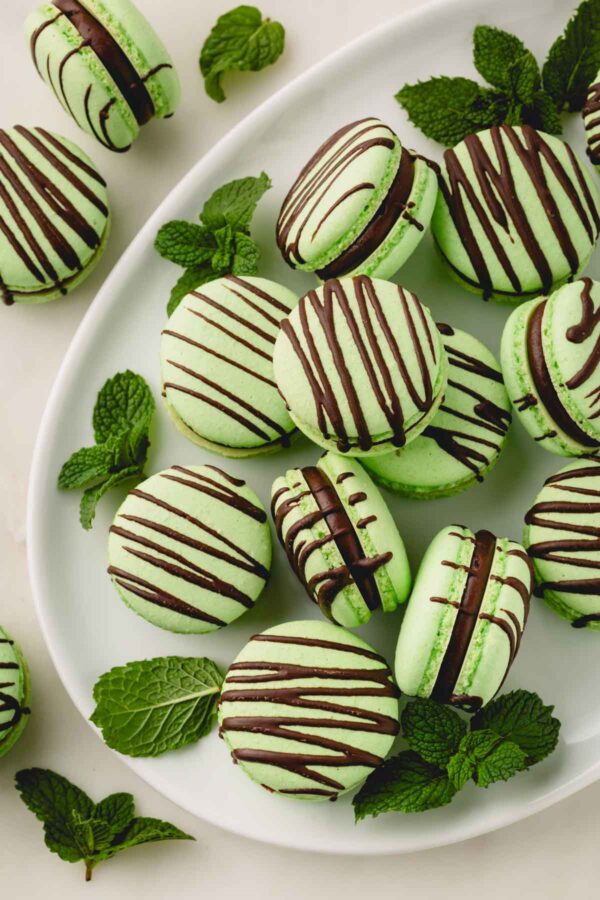
I’ve made a lot of macaron recipes over the years, like my mint chocolate macarons and funfetti macarons, but these cranberry orange macarons might be my most unique flavor variation yet!
- One recipe makes a large batch, perfect for sharing. As written, this recipe makes 20 filled macarons, meaning it’s perfect for preparing a dessert platter or dividing up for gifting.
- The flavor is sweet and tangy without being overpowering. With two kinds of fillings, every bite is sweet, citrusy, tangy, and chocolatey, making for a well-rounded treat.
- Macarons are great to make in advance. I like to prep my macarons a few days ahead of time when hosting to take the stress out of holidays.
One bite, and these might become your favorite macarons ever!

Pin this now to find it later
Pin ItKey Ingredient Notes
For the best results, measure all your ingredients with a kitchen scale!
- Almond flour – Use super-fine almond flour with a light beige color and a fluffy texture. Blue Diamond almond flour is my favorite! Avoid oily flours, and follow my tips for how to salvage oily almond flour, if needed.
- Powdered sugar – I don’t recommend making your own powdered sugar. Commercial powdered sugar has cornstarch in it, which helps with the texture of the macaron shells.
- Egg whites – Stable meringue starts with quality egg whites. Choose fresh eggs, carefully separate the whites and yolk, and weigh the amount precisely. I’ve also had success with carton egg whites. Just be sure to check the labels and avoid the ones that say “not for meringue”.
- Granulated sugar – I use fine granulated sugar for meringue, because it dissolves more quickly than other types of sugar. You can also use caster sugar, aka baker’s sugar, if preferred.
- Cream of tartar – This is technically optional and can be omitted. However, I always include it because it helps stabilize the egg whites, creating a sturdier meringue.

How to make cranberry orange macarons
Before you begin, be sure to check out my macaron troubleshooting guide and gather my 9 essential tools to make perfect macarons!
1. Make the macaron batter
- Sift the almond flour and powdered sugar twice. Discard any leftover chunky pieces left in the sifter.
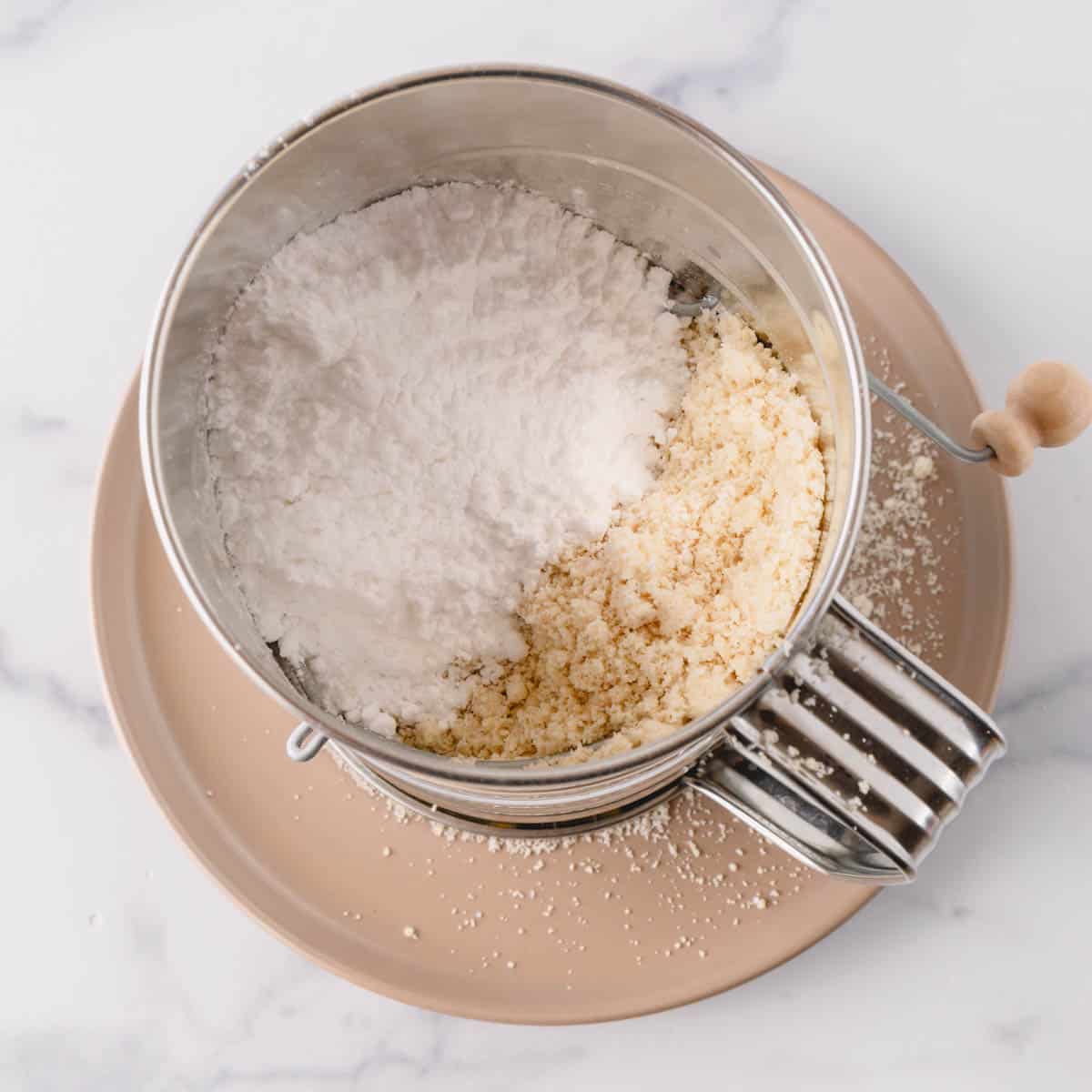
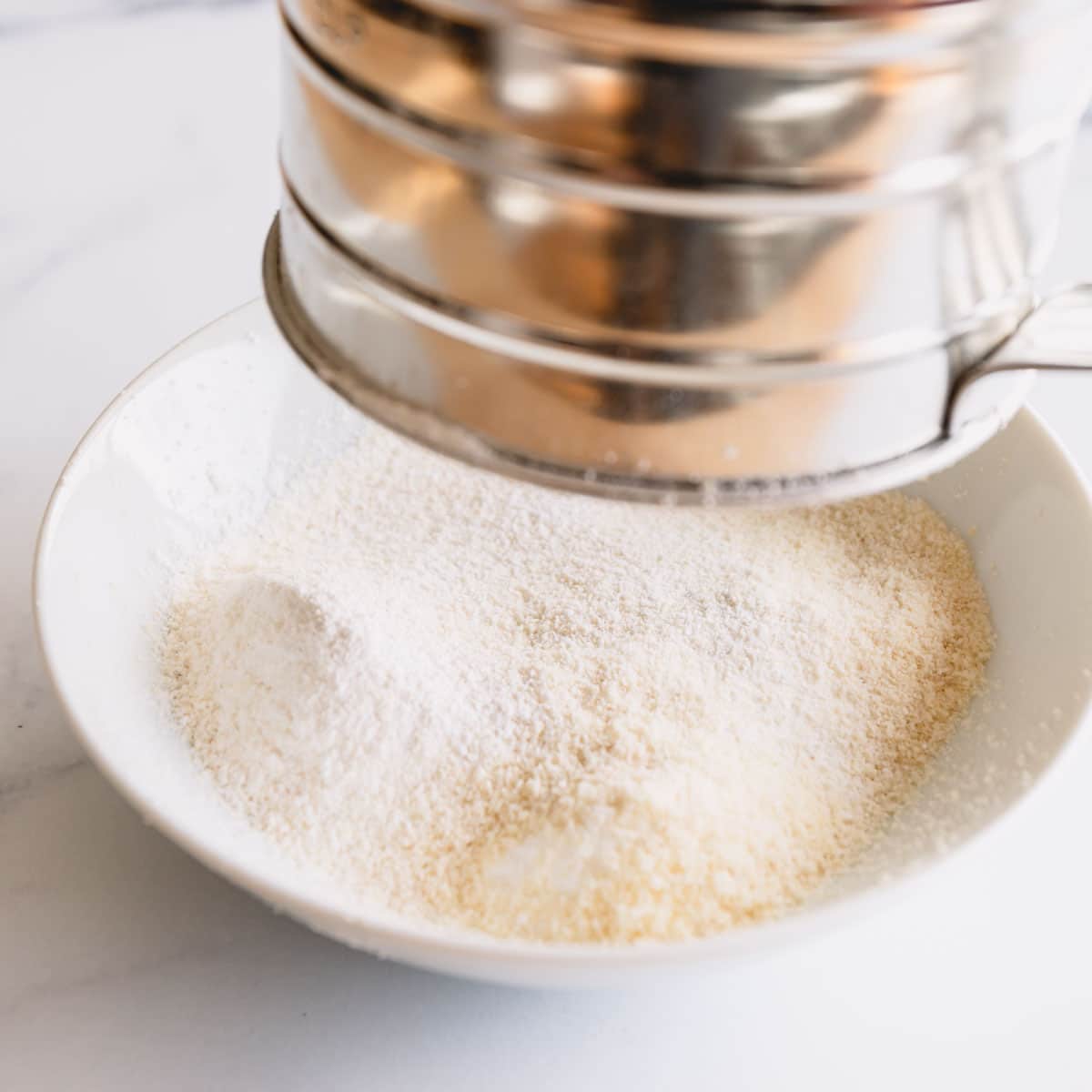
- Make the meringue by beating the egg whites, granulated sugar, cream of tartar, and salt on medium speed until soft peaks form. Be patient here! It takes me about 30-40 minutes with my stand mixer on speed 4.


- Add a few drops of gel food coloring to the meringue. I used about 1 teaspoon of Americolor Burgundy gel food coloring.
- Beat at medium speed until hard peaks form. At this stage, the meringue should ball up inside the whisk and hold a pointy tip when lifted from the bowl.


- Sift the almond flour mixture into the meringue.

- Fold the dry ingredients into the meringue with a large silicone spatula.
- Fold the batter until it’s runny enough to fall into a ribbon. The batter should be lava-like: thick enough to hold its shape yet runny enough to slowly flow off the spatula.


Test the batter consistency
Drop a small amount of batter into the bowl. If small peaks dissolve into the batter on their own, it’s ready. If not, fold the mixture a couple more times, and test again. Just be careful not to over-fold!
2. Pipe the macaron shells and bake
- Transfer the batter into a 16-inch piping bag fitted with a round tip. (I recommend the Wilton 2A tip.)
- Hold the pastry bag at a straight 90° angle, and pipe 1.5-inch rounds about an inch apart on prepared baking sheets.
- Tap the baking sheets firmly on the counter to get rid of any air bubbles. You can also slap the bottom of the baking sheet with one of your hands. Use a toothpick to burst any large air bubbles. This ensures smooth tops!


Make piping easy
Download my free macaron template to take the guesswork out of piping the batter.
- Rest the macarons on the counter for 15 minutes.
- Bake the macaron shells on the middle rack until set. Work with just one baking sheet at a time, cooking in batches! To test for doneness, gently try to touch a macaron. If it slides and wobbles, continue to bake for another minute or so. Fully cooked macarons should be firm to the touch, and the base shouldn’t move!
- Cool the macarons completely at room temperature, and remove the shells from the baking surface.


3. Make the cranberry sauce filling
I recommend making this sauce a day in advance to give it a plenty of time to chill.
- Combine the cranberries, water, sugar, orange zest, cinnamon, and salt in a medium saucepan.
- Simmer the mixture over medium heat, stirring occasionally, until the sauce thickens slightly but is still runny. It’ll continue to thicken slightly as it cools!
- Remove the pan from the heat, and discard the cinnamon stick.
- Stir in the orange liqueur.
- Blend the sauce until smooth. I like to use an immersion blender. However, you can also let it cool slightly and transfer it to a regular blender.
- Cool completely, and transfer the sauce to the refrigerator until you’re ready to use it.


4. Make the orange ganache
- Melt the white chocolate in the microwave set at 50% power in 15-second intervals. You can also use a double boiler, if preferred!
- Place the cream in a small saucepan.
- Add the orange zest.
- Warm the cream over medium heat until small bubbles form around the edges. There’s no need to bring it to a boil!


- Add ⅓ of the warm cream mixture to the melted chocolate, and stir to combine. It will look grainy and seized at this point, but don’t worry!
- Stir in another ⅓ of the cream, mixing until smooth. Then, add the remaining cream, stirring until the mixture is silky.
- Blend the ganache with an immersion blender. This is technically optional, but helps create a better emulsion and a smoother ganache!
- Transfer the ganache to a flat container or a baking pan.
- Cover the ganache with plastic wrap, making sure it touches the entire surface to prevent a skin or film from forming on top.
- Refrigerate to thicken and stabilize the ganache, ideally overnight or for at least 5 hours!
- Stir the ganache to soften it and restore its shine.


5. Assemble the orange cranberry macarons
- Pair the macaron shells by size, and arrange them on a wire rack, lining them up so the bottom shells are upside down.
- Pipe a ring of orange ganache filling on the bottom shells.
- Pipe ½ teaspoon of the cranberry sauce filling into the center of each macaron.
- Place the top shells over the filling, pressing lightly so the filling spreads to the edges.
- Refrigerate the filled macarons in an airtight container for at least 24 hours.
- Bring the macarons back to room temperature, and enjoy!


Add decoration
Mix gold dust with a teeny tiny bit of vanilla extract. Dip a brush in the gold paint, and either splatter it or brush it onto the shells. You can also use Everclear or vodka.

6. Mature macarons
- Rest the assembled macarons in the refrigerator for 8-12 hours before serving. This allows the flavors to meld and the shells to soften slightly, resulting in a perfect, chewy interior.
- Bring the macarons to room temperature before serving. (About 30 minutes on the counter.)
The cranberry sauce is a wet filling that softens the macaron more quickly. That’s why these macarons require less time to mature. Watch this video to learn more about maturing macarons.

Tips for Success
- Prevent hollow macarons. Before you begin, read over my tips to fix hollow macarons.
- Weigh your ingredients. Even small measurement errors can throw off the texture of macarons. To eliminate any wiggle room, use a kitchen scale to measure all the ingredients.
- Use room-temperature egg whites. Cold egg whites won’t whip as efficiently. Let them sit out for 30-60 minutes before starting, and make sure there’s no trace of yolk in the whites.
- Sift the dry ingredients thoroughly. Sifting the almond flour and powdered sugar twice helps create ultra-smooth shells. Discard any large almond bits that won’t pass through the sieve!
- Master the macaronage. Folding the batter to the right consistency is key. Stop as soon as the batter flows like lava, and you can draw a figure eight without the ribbon breaking. Over-folding will lead to flat, spread-out shells, which we definitely don’t want!
- Use gel food coloring sparingly. Liquid food coloring can thin the batter. A few drops of gel coloring added at the soft-peak stage are plenty to achieve a rich burgundy color.
- Rest the shells before baking. Letting the piped macarons sit for about 15 minutes helps form a skin, which encourages proper “feet” and prevents cracking in the oven.
- Mature the filled macarons. Resting the assembled macarons in the refrigerator for 24 hours allows the flavors to meld and the shells to soften slightly for a perfect chewy interior.
Make-Ahead
Store plain macaron shells in an airtight container at room temperature for up to 7 days, or freeze them for up to 3 months.
Transfer cooled cranberry sauce filling to an airtight container, and store it in the fridge for up to 5 days or in the freezer for up to 3 months. Thaw in the fridge overnight, and bring it to room temperature before assembling the orange cranberry macarons.
Storage
Once assembled, transfer leftover macarons to an airtight container and store them in the fridge for up to 3 days. Or, freeze them for up to 1 month. Make sure there’s no moisture in the container, or your macarons will become soggy!
Bring your macarons to room temperature before serving, and they’ll taste as good as new.

FAQs
Cracked macaron shells are usually caused by trapped air or baking the shells before they’ve formed a proper skin. To avoid this, make sure to firmly tap the baking sheets to release air bubbles and pop any large ones with a toothpick. Then, let the piped shells rest until they’re dry to the touch before baking. Cracks can also happen if the oven temperature is too high or if the meringue is under-whipped. So, use an oven thermometer and whip the meringue to stiff peaks.
Macarons without feet are often the result of over-mixed batter, an unstable meringue, or skipping the resting step. Over-folding deflates the air needed for lift, while under-whipped meringue won’t create enough structure. Be sure to fold just until the batter flows like lava and holds a ribbon for a few seconds. Letting the shells rest until a skin forms is also key to encouraging feet to develop.
Lopsided macarons usually come from uneven piping or uneven heat in the oven. Hold the piping bag straight at a 90° angle and apply even pressure when piping. If your oven has hot spots, rotate the tray halfway through baking. Using an oven thermometer and baking one tray at a time also helps ensure consistent heat for evenly shaped shells.
More Macaron Recipes

Cranberry Orange Macarons
Ingredients
FOR MACARON SHELLS:
- 100 g super-fine almond flour Note 1
- 65 g powdered sugar Note 2
- 70 g egg whites at room temperature Note 3
- 75 g fine granulated sugar Note 4
- ¼ teaspoon cream of tartar optional Note 5
- ¼ teaspoon coarse kosher salt
- Burgundy gel food coloring
FOR CRANBERRY SAUCE FILLING:
- 4 oz (115 g) cranberries washed
- 1/3 cup (80 ml) water
- ¼ cup (50 g) granulated sugar
- ½ tablespoon orange zest
- 1 cinnamon stick
- ¼ teaspoon table salt
- 2 teaspoons orange liquor such as Grand Marnier
FOR ORANGE GANACHE:
- 8 oz (227 g) 35% white chocolate Note 6
- 4 oz (113 g) heavy whipping cream
- Zest of 1 naval orange
Instructions
TO MAKE MACARON SHELLS:
- Preheat the oven to 300°F (150°C). Line 2 baking sheets with parchment paper, a Teflon sheet, or a silicone mat.
- To prepare the dry ingredients, sift the almond flour and powdered sugar together twice. (Note: If you have up to 2 tablespoons of chunky dry ingredients left in the sifter, you don't have to replace it. Simply discard those chunky bits.)
- To make meringue, in a clean mixing bowl with a whisk attachment, combine egg whites, granulated sugar, cream of tartar and salt and beat the mixture on medium speed until soft peaks form. (I set it to speed 4 on my KitchenAid stand mixer. It takes 30-40 minutes to whip the meringue, but it's well worth it for nice and full shells.)
- Add a few drops of the gel food coloring at the soft peak stage. ( I used about 1 teaspoon for a deep saturated color.)
- Continue beating the meringue at the same medium speed until hard peaks form. Visual cues: Meringue should ball up inside the whisk, and when you lift the whisk, the meringue should hold a pointy end and have sharp ribs.
- To make batter, sift the almond flour mixture into the meringue. Using a silicone spatula, fold the dry ingredients into the meringue until fully incorporated. Then continue to fold the batter until it’s runny enough to draw a figure eight. To test, take a small amount of batter and drop it into the bowl. If the small peaks dissolve into the batter on their own in about 10 seconds, the batter is ready. If not, fold a couple more times and test again. Be careful not to over-fold the batter. (TIP: Making French macarons is all about the technique. This is one of the most crucial steps. Let me try to describe the folding motion as best as I can: run the spatula clockwise from the bottom, up around the sides, and cut the batter in half. If you’re a beginner macaron-baker, I suggest counting every fold. It takes roughly 50 folds to reach the proper consistency. After 50 folds, start testing the batter, and continue testing after every couple of folds.)
- To pipe macaron shells, transfer the batter into a pastry bag, fitted with a round tip. (I use this Wilton 2A tip.)
- Hold the pastry bag at a straight 90° angle and pipe about 1.5-inch rounds about an inch apart on prepared baking sheets. (TIP: Download my free macaron template. Simply pipe the batter to fill the inner circle.)
- Tap the baking sheets firmly on the counter (or slap the bottom of the baking sheet with one of your hands) a few times to get rid of any air bubbles. You can also use a toothpick to burst some large air bubbles. This step ensures smooth tops.
- Let the macarons rest on the counter for 15 minutes before baking.
- To bake, bake the macarons for 15-18 minutes, one baking sheet at a time, on the middle rack. It’ll take longer for larger macarons. To test doneness, lightly touch a macaron and try to move it. If it slides and wobbles, bake a minute or so longer. The cooked macarons should be firm to the touch, and the base shouldn’t move.
- Cool the macarons completely and then remove the shells from the baking surface. (TIP: Don't remove the shells while warm; you may risk breaking the shells, or the bottom might get stuck to the baking surface.)
TO MAKE CRANBERRY SAUCE FILLING:
- In a medium saucepan, combine cranberries, water, sugar, orange zest, cinnamon stick, and salt.
- Simmer the mixture over medium heat, stirring occasionally, for about 10 minutes. The sauce should be slightly thickened, but still runny. It’ll thicken more as it cools.
- Remove from heat and discard cinnamon stick.
- Stir in orange liqueur.
- Using an immersion blender, blend the sauce until smooth.
- Cool completely. Then refrigerate until ready to use.
- Transfer the cranberry filling into a piping bag.
TO MAKE ORANGE GANACHE:
- In a microwave-safe bowl, melt white chocolate in a microwave. Set it for 1 minute at 50% power (for a 1000-watt microwave!). Stir well, then put it back for 15-30 seconds at 50% power, depending on the consistency. (If it looks pretty solid, put it for 30 seconds, and if it starts melting, for 15 seconds.) Then stir well and put it back for another 15 seconds at 50% power, if needed, or until the chocolate is completely melted, stirring well every 15 seconds. (Alternatively, you can use a double boiler to melt the chocolate.)
- Place the cream in a small saucepan.
- Add the orange zest.
- Warm the cream over medium heat until small bubbles form around the edges. No need to scald/boil it.
- Add 1/3 of the cream into the melted chocolate and stir gently with a spatula or a whisk. It’ll look grainy and seized, but don’t worry.
- Stir in another 1/3 of cream and mix until almost smooth. Then add the last of the cream, and it should turn silky smooth.
- Optional, but highly recommended: Blend the ganache with an immersion blender for 30 seconds. This creates a better emulsion and smoother ganache!
- Transfer the ganache into a flat container, or a baking pan (it helps to set the ganache quickly!).
- Cover with plastic wrap, touching the entire surface of the ganache to prevent any skin from forming.
- Refrigerate for at least 5 hours, or overnight, to thicken and stabilize the ganache. After the chilling time, the ganache should be nice and thick, but not stiff, and hold its shape when piped.
- Stir the ganache with a rubber spatula to soften it and restore the shine.
TO ASSEMBLE MACARONS:
- Pair the macaron shells by size and arrange them on a wire rack. Line them up so that the bottom shells are upside down.
- Pipe a ring of ganache filling on the bottom shells.
- Pipe ½ teaspoon of cranberry sauce filling in the center of each macaron.
- Place the top shell over the filling and press lightly so the filling spreads to the edges.
- Refrigerate the filled macarons in an airtight container for at least 24 hours to mature, allowing the filling to soften and infuse the shells with flavor.
- To serve, bring the macarons out about 30 minutes prior to serving.
⭐️ Did you make this recipe?
Please leave a review and let us know how you liked it!
Tips & Notes
Nutrition