

Learn how to make a perfect vegan macaron recipe filled with a creamy, fruit-infused ganache! I’ll walk you through all my tips, tricks, and techniques for achieving macarons so beautiful and tasty that no one will even realize they’re plant-based.

I’m a self-proclaimed macaron expert. I have many macaron recipes, like my pure white macarons and pistachio macarons, and even released a cookbook, Macaron 101: A Comprehensive Guide!
About 4 months ago, I set out to make vegan French macarons. Despite over a decade of macaron baking experience, vegan macarons proved to be one of the most challenging projects I’ve undertaken.
After dozens of failed batches and numerous experiments with different aquafaba liquids, I’m pleased to report that I persevered through the challenge and produced four successful vegan macarons in a row and counting!
And I’m ready to share all the lessons I’ve learned along the way. Each failed macaron batch taught me a valuable lesson. And we’ve enjoyed countless macaron brownie cookies, so no complaints on my part!


Pin this now to find it later
Pin It3 Lessons I Learned about Vegan Macarons
While it may seem like a straightforward process, vegan macarons aren’t just about swapping out egg whites with aquafaba. Here are three main lessons I learned about aquafaba macarons.
- Macaron batter made with aquafaba takes way less mixing. Once all the dry ingredients have been incorporated, be careful not to overmix the batter. Forget about drawing a figure 8 with the batter, as it’ll be overmixed at that point.
- The number one issue I was having was cracked and erupted macaron shells. This issue was solved by reducing the oven temperature. My shells turned out nice and smooth once I reduced the oven temperature by 15 degrees below my regular macaron baking temperature.
- Also, I switched from my go-to Teflon sheets to silicone mats to further insulate the baking surface. This helped with eliminating lopsided shells.
Read “Tips for Success” below for additional tips.
Key Ingredient Notes
- Aquafaba – I’ve tested this recipe with chickpea water from a can of garbanzo beans and dry aquafaba powder. Both perform similarly and have their own pros and cons. I personally prefer using aquafaba powder, as it requires the least effort to prepare. I noticed it whips better when you let the mixture rest for 30 minutes or so after mixing.
- Almond flour – Choose super-fine almond flour with a light beige color and fluffy texture. Follow my tips to dry out oily almond flour if you find your flour to be a little greasy.
- Powdered sugar is crucial in every good macaron, sweetening the shells and providing structure.
- Granulated sugar – Use fine granulated sugar, aka caster sugar or baker’s sugar, as it dissolves faster.
- Cream of tartar -I’ve tested the recipe with and without cream of tartar. Cream of tartar is necessary, contributing to sturdy shells!
- Salt balanaces the sweetness for a well-rounded flavor.

Aquafaba powder
I bought aquafaba powder on Amazon. While it may look pricey, it’s a LOT of aquafaba, enough for 60 batches!
How to make vegan macarons step by step
If you’re new to macarons, take a look at my easy macaron recipe for beginners, and be sure to check out my macaron troubleshooting guide before you begin!
Then, gather the 9 essential tools to make perfect macarons.
1. Preheat the oven
Before you begin, preheat your oven to 275°F, and line two baking sheets with silicone mats.

Note the lower oven temperature
During my testing, I’ve discovered that aquafaba meringue is heat-sensitive and requires a lower oven temperature than regular macarons.
2. Prepare the aquafaba
I recommend preparing the aquafaba liquid at least 30 minutes in advance. In my experience, it whips better when it has been rested.
- Mix the water and aquafaba powder in a small bowl until the mixture is smooth.
- Cover and let it rest for 30 minutes.

Chickpea water
You can also use a can of chickpea water instead of dry aquafaba powder. If using a can of chickpea water, check out my vegan meringue post for step-by-step instructions on preparing chickpea water.
You’ll need 65g of reduced chickpea water, and 1 (16oz) can yields enough for two batches of macarons.
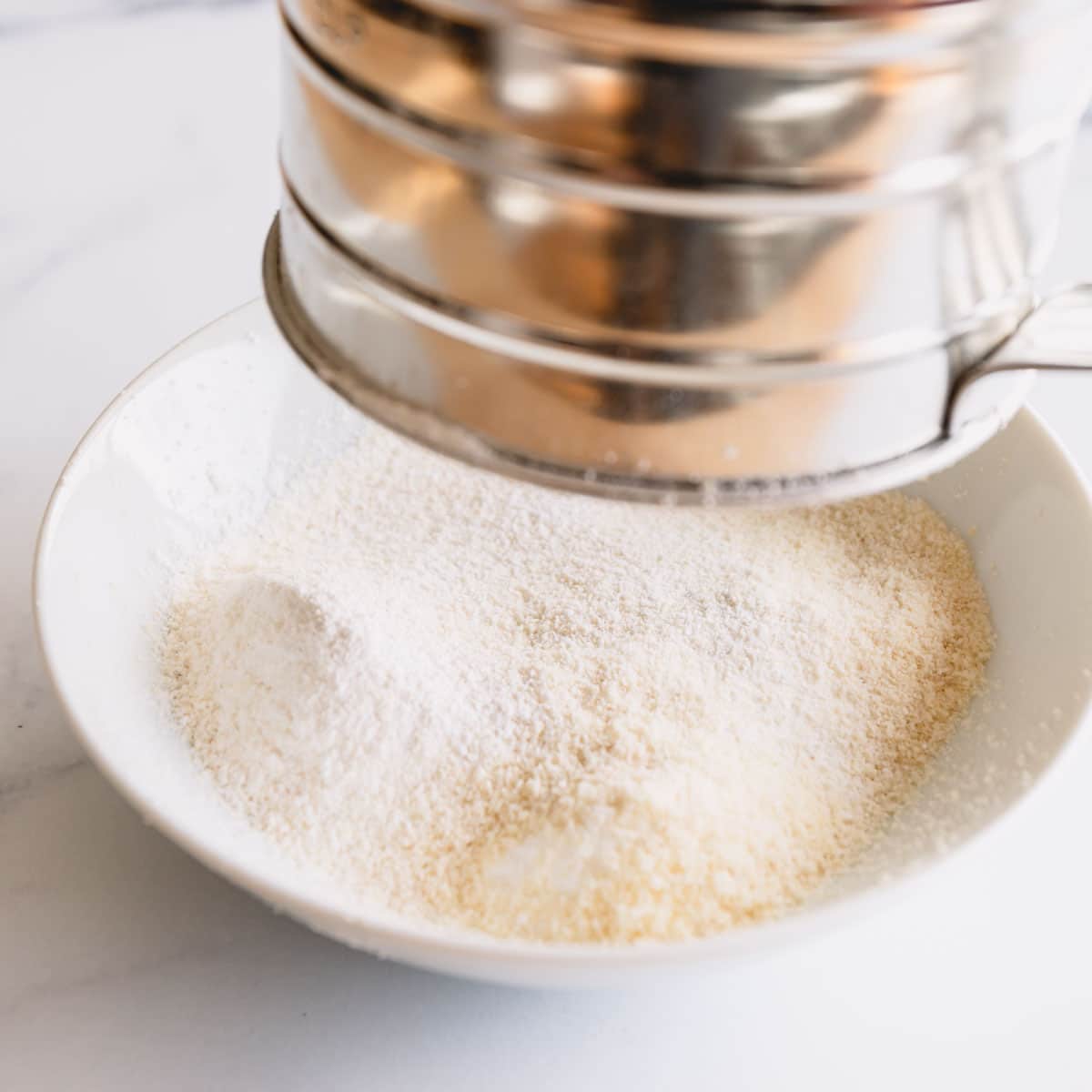
3. Sift the dry ingredients
- Sift the almond flour and powdered sugar twice.
- Discard any chunky bits left in the sifter. You don’t have to replace it if it’s less than 2 tablespoons.
4. Make the vegan meringue
- Combine the aquafaba liquid, granulated sugar, cream of tartar, and salt in a mixing bowl.
- Whip the mixture using an electric hand mixer on high speed until stiff peaks form. If you’re making colored shells, add gel food coloring at the soft peak stage.
It takes about 15 minutes to reach stiff peaks with an electric hand mixer, and 40 minutes with a stand mixer.

What does stiff peak mean?
Your meringue should be super thick and ball up inside the whisk. When you lift the whisk, the meringue should hold a pointy end and have sharp ribs.
5. Mix the macaron batter
- Sift the almond flour mixture into the meringue and fold it in until fully incorporated.
- Continue to fold the batter until it begins to loosen up. Be careful not to overmix! Vegan macaron batter loosens more quickly than regular macaron batter.

Test the batter
Take a small amount of batter and drop it into the bowl. Tilt the bowl and see how the batter flows. If the edges of the dropped batter slowly melt back into the batter in about 15 seconds, the batter is ready. If not, fold it a couple more times and test again. Be careful not to over-fold the batter.
6. Pipe the macaron shells
- Transfer the batter to a pastry bag fitted with a round tip. I use a Wilton 2A tip!
- Pipe about 1.5-inch round, about an inch apart on the prepared baking sheets, holding the pastry bag at a straight 90° angle.

Pipe perfect shells
Download my free macaron template for piping tips to ensure your shells turn out perfectly.
7. Bake the macarons
- Tap the baking sheets firmly on the counter. Or, slap the bottom of the baking sheet with one of your hands! This removes any air bubbles. You can also use a toothpick to burst some of the larger bubbles, ensuring smooth tops.
- Rest the macarons on the counter for 15 minutes.
- Bake for 20 minutes, one baking sheet at a time.
- Cool completely, and remove the shells from the baking surface.

Test for doneness
Touch a macaron lightly, and try to move it. If it slides and wobbles, bake another minute or so to set. Fully cooked macaron shells should be firm to the touch, and the base shouldn’t move.
8. Make the vegan ganache
- Melt the chocolate in a microwave and heat the coconut cream in the microwave for 30-45 seconds.
- Stir the warm coconut cream into the melted chocolate in three stages.
- Add freeze-dried strawberry powder and salt and mix until just combined.
- Blend the ganache with an immersion blender for about 30 seconds.
- Transfer the ganache into a flat container and cover the entire surface with plastic wrap to prevent a skin from forming.
- Set the ganache at room temperature for about 2 hours, or overnight, before using it to fill macarons. (You may refrigerate it for about 30 minutes to expedite the process.)
- Transfer the ganache to a piping bag fitted with a round piping tip.

9. Assemble and mature the macarons
- Pair the macaron shells by size, and arrange them on a wire rack, placing the bottom shells upside down.
- Pipe a dollop of filling on the bottom shells.
- Place a top shell over the filling, and press lightly so that the filling spreads to the edges of the shell.
- Refrigerate the vegan macarons in an airtight container for at least 24 hours. This allows the filling to soften and flavor the shells.


Tips for Success
- Avoid previously frozen chickpea water. In my experience, freezing reduced chickpea water didn’t whip into stiff peaks.
- Keep an eye on the meringue as you whip. It should ball up inside the whisk. Then, when you lift the whisk, the meringue should hold a pointy end and have sharp ribs.
- Be careful not to overmix the batter! Vegan meringue tends to loosen faster. Run the spatula clockwise from the bottom, up around the sides, and cut the batter in half. If you’re a beginner macaron baker, I suggest counting every fold. It takes roughly 40 folds to reach the proper consistency. After 40 folds, start testing the batter, and continue testing after every couple of folds.
- Avoid high heat. Aquafaba meringue is heat-sensitive. I learned this lesson the hard way when I first made vegan meringue! Ensure the oven temperature is set to 275°F, or about 15 degrees below the regular macaron baking temperature for your oven.
- Also, baking macarons on a silicone mat helped me resolve lopsided macarons.

Make-Ahead Tips
- Store unfilled macaron shells in an airtight container at room temperature for up to 5 days, or freeze them for up to 3 months.
Storing Tips
- Store filled vegan macarons in an airtight container at room temperature or in the refrigerator for up to 5 days.
- Freeze assembled macarons in an airtight container for up to 1 month. To thaw, place the frozen macarons in the fridge and let them thaw slowly for at least 1 hour.

FAQs
There are many different factors involved in making perfect macarons. For example, the following should be done just right to achieve the desired macarons: stable meringue, proper mixing technique, low humidity, and accurate oven temperature, just to name a few. Add in the element of removing animal-based items for this vegan macaron recipe, and the challenges become even more difficult. That’s why it’s important to experiment and improve your technique to make perfect macarons.
There is no one exact secret to perfecting macarons. The end result is dependent on using high-quality ingredients, proper measurements, and the proper techniques. It can be a bit of a trial and error, but the process becomes easier the more you practice!
Yes, start with the basic vegan ganache base, and experiment with different mix-ins like cocoa powder, freeze-dried raspberries, etc., to make the flavor your own.
More Macaron Recipes

Vegan Macaron Recipe
Ingredients
For aquafaba:
Method 1:
- 60 g water
- 5 g aquafaba powder Note 1
Method 2:
- 1 (16 oz) can chickpeas Note 2
For macaron shells:
- 100 g almond flour Note 3
- 65 g powdered sugar
- 65 g aquafaba liquid Note 4
- 70 g granulated sugar Note 5
- ¼ teaspoon cream of tartar Note 6
- ¼ teaspoon coarse kosher salt
For vegan strawberry ganache:
- ½ cup (100 g) white chocolate chips
- 1/3 cup (80 g) canned coconut cream Note 7
- 1 tablespoon (15 g) freeze-dried strawberry powder
- 1/8 teaspoon coarse kosher salt
Instructions
To prepare the aquafaba liquid:
Method 1:
- In a small bowl, whisk together water and aquafaba powder until smooth. Cover and let it sit for 30 minutes.
Method 2:
- Drain the liquid into a small saucepan.
- Simmer the liquid for about 25 minutes over medium heat to reduce by half.
- Cool the reduced liquid completely before making meringue.
To make macaron shells:
- Preheat the oven to 275°F (135°C). Line 2 baking sheets with silicone mats.
- To prepare the dry ingredients, sift together almond flour and powdered sugar twice. (Note: If you have up to 2 tablespoons of chunky dry ingredients left in the sifter, you don’t have to replace it. Simply discard those chunky bits.)
- To make the vegan meringue, in a clean bowl, combine aquafaba liquid, granulated sugar, cream of tartar, and salt.
- Using an electric hand mixer, whip the mixture on medium speed until stiff peaks form. If you’re making colored shells, add gel food coloring at soft peak stage. Visual cues: Meringue should ball up inside the whisk, and when you lift the whisk, the meringue should hold a pointy end and have sharp ribs. (This step takes about 15 minutes with a hand mixer.)
- To make batter, sift almond flour mixture into the meringue. Using a silicone spatula, fold the dry ingredients into the meringue until fully incorporated. Then continue to fold the batter until it’s start to loosen up. Be careful not to overmix the batter. I noticed that batter tends to loosen faster with vegan meringue.
- To test the consistency of the batter, take a small amount of batter and drop it into the bowl. If the small peaks dissolve into the batter on its own in about 15 seconds, the batter is ready. If not, fold a couple more times and test again. Be careful not to over-fold the batter. (TIP: Making french macarons is all about the technique. This is one of the most crucial step. Let me try to describe the folding motion as best as I can: run the spatula clockwise from the bottom, up around the sides and cut the batter in half. If you’re beginner macaron-baker, I suggest to count every fold. It takes roughly about 40 folds to reach the proper consistency. After 40 folds, start testing the batter, and continue testing after every couple folds.)
- To pipe macaron shells, transfer the batter into a pastry bag, fitted with a round tip. (I use this Wilton 2A tip.)
- Hold the pastry bag at straight 90° angle and pipe about 1.5-inch rounds about an inch apart on prepared baking sheets. (TIP 2: Download my free macaron template. Pipe the batter to fill the inner circle.)
- Tap the baking sheets firmly on the counter (or slap the bottom of the baking sheet with one of your hands) a few times to get rid of any air bubbles. You can also use a toothpick to burst some large air bubbles. This step ensures smooth tops.
- Let the macarons rest on the counter for 15 minutes before baking.
- To bake, bake the macarons for 20 minutes, one baking sheet at a time, on the middle rack. It’ll take longer for larger macarons. To test for doneness, touch a macaron lightly and try to move it. If it slides and wobbles, bake a minute or so longer. The cooked macarons should be firm to touch and the base shouldn’t move.
- Cool the macarons completely and then remove the shells from the baking surface. (TIP: Don’t remove the shells while warm; you may risk breaking the shells, or the bottom might get stuck to the baking surface.)
To make the vegan ganache filling:
- Melt the chocolate in a double boiler or microwave.
- Heat coconut cream in the microwave for 30-45 seconds. It should be around 110°F (45°C).
- Add a third of the warm cream to the melted chocolate and stir gently with a spatula. It will look grainy and seized, but don’t worry. Stir in another third of the cream and mix until almost smooth. Then stir in all the remaining cream–it should turn silky smooth.
- Add freeze-dried strawberry powder and salt and mix until just combined.
- Using an immersion blender, blend the ganache for about 30 seconds.
- Transfer the ganache into a flat container and cover the entire surface with plastic wrap to prevent a skin from forming.
- Let the ganache set at room temperature for about 2 hours, or overnight, before using it to fill macarons. (You may refrigerate it for about 30 minutes to expedite the process.)
- Transfer the ganache into a piping bag fitted with a round piping tip.
To assemble the macarons:
- Pair the macaron shells by size and arrange them on a wire rack. Line them up so that bottom shells are upside down.
- Pipe a dollop of filling on bottom shells. Place the top shell over the filling and press lightly so the filling spreads till the edges.
- Refrigerate the filled macarons in an airtight container for at least 24 hours to mature, which allows the filling to soften and flavor the shells.
- To serve, bring the macarons out about 30 minutes prior to serving.
⭐️ Did you make this recipe?
Please leave a review and let us know how you liked it!
Tips & Notes
Nutrition



Can you please translate this into the imperial system for us Americans?
Hi, there! I don’t recommend measuring the ingredients by volume.
I have tried making vegan macarons now twice with reduced liquid aquafaba, and the result is a disaster. I feel like my batter is not runny/liquid enough. What do I do wrong? Over- or underwhip the aquafaba? The batter does not seem to get looser when folding.