

This creamy rich lobster bisque is loaded with tender chunks of lobster meat in an easy homemade broth. This restaurant-quality bisque will leave you more than satisfied!
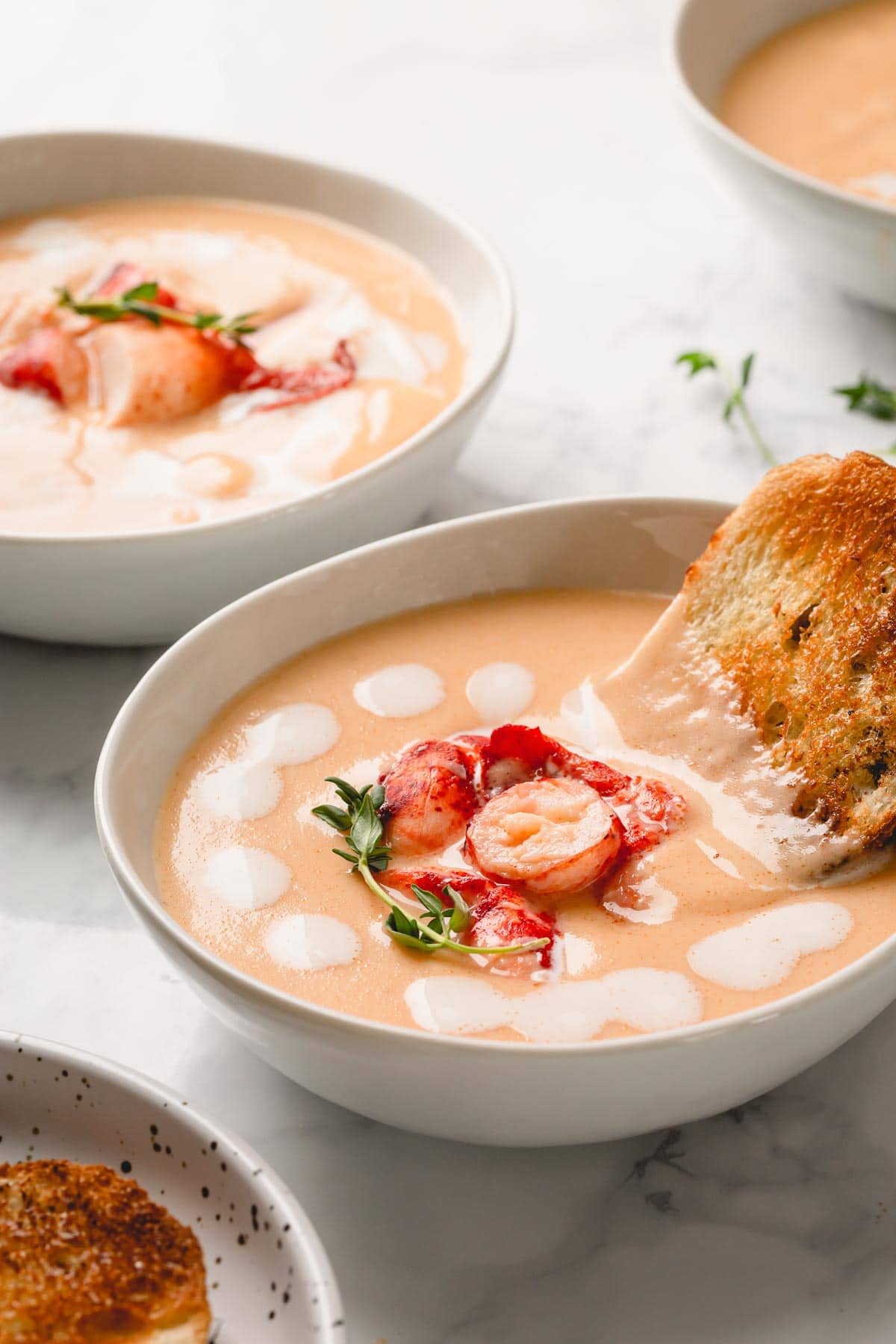
Why you’ll love this lobster bisque
Years ago, I got my first taste of lobster bisque at a fancy restaurant in Medora, ND, and I immediately fell in love. It was rich, creamy, and SO delicious!
Medora is a small tourist town that only opens during the summer. So, I used to look forward to going every year. However, after having a baby (and now two), driving 40+ minutes for lobster bisque became less exciting.
As it turns out, it’s actually easy to make lobster bisque at home! The secret is to make a good lobster stock, but don’t worry I’ll walk you through all the steps.
- Flavor – Every bite is bursting with rich, savory, butter flavor.
- Texture – The bisque itself it smooth and creamy. Then, we add chunks of lobster for a satisfying texture.
- Easy – This recipe for lobster bisque does require a bit of planning, but the steps are simple and easy to follow.
Once you learn how to make lobster bisque at home, you’ll never want restaurant-versions again! Pair it with a side of garlic bread and a crisp salad, and your friends and family are guaranteed to be impressed.
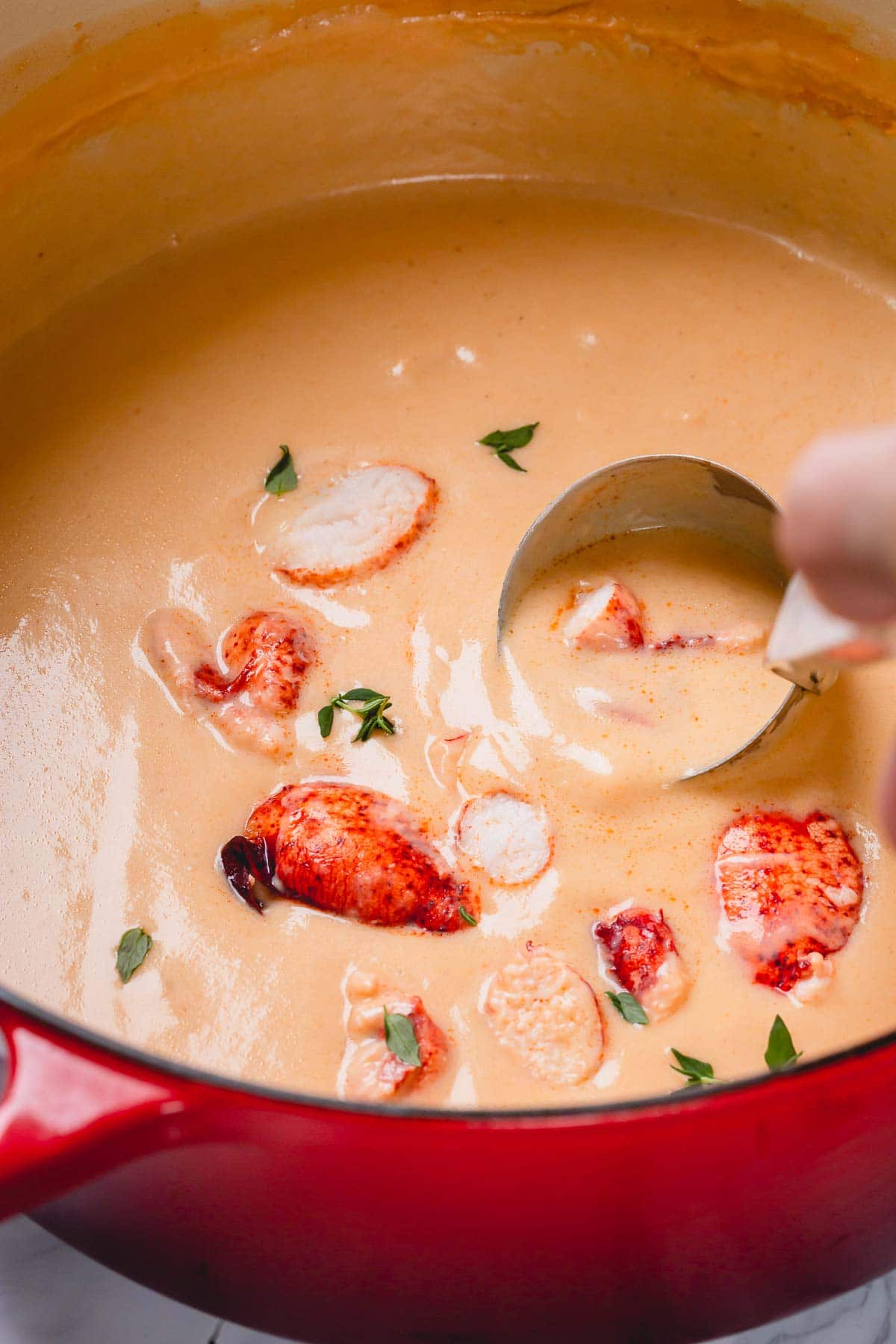
Key Ingredient Notes
For the Lobster Broth
- Lobster tail – Use a thawed one-pound lobster tail. See my tips below for how to choose and prepare lobster tails. It’s not as intimidating as you may think!
- Unsalted butter – If salted butter is all you have, just omit the added salt so your bisque isn’t overpoweringly salty.
- Aromatic veggies – Shallot, celery, and garlic cloves create a sweet, savory flavor base for the bisque.
- White wine – This helps deglaze the pan and adds a bright, acidic taste. Make sure to choose a white wine you like to drink!
- Tomato paste thickens the soup and creates the classic tomato flavor we want in a bisque.
- Chicken stock – I always recommend using low-sodium chicken stock. If needed, vegetable stock will also work.
- Herbs – Freshy thyme, fresh tarragon, and bay leaves create a bright, herbaceous flavor that balances some of the heaviness of the fats for a well-rounded taste.
For the Bisque
- Butter creates the rich, savory flavor base we want.
- Bacon fat – You can substitute the bacon fat with more butter, but I love the slightly smokey flavor.
- Flour – All-purpose flour combines with the fat to create a roux, which helps thicken the bisque.
- Heavy whipping cream enhances the rich flavor and creates the creamy consistency that makes bisque so irresistible.
Choosing and preparing lobster
- Choose cold-water lobster tail. Wait, there are warm-water lobster tails, too? You bet! Coldwater lobsters are basically a premium version. Sure, you’ll pay a bit more, but you’ll get tastier and whiter lobster meat with a firmer texture. It’s totally worth it!
- Fresh lobster is great and all, but frozen ones will work too! Thaw frozen lobster tails before cooking. And if you’re like me, you probably forgot to transfer lobster tails into the fridge to thaw nice and slow overnight. Don’t fret, though, because I have a tip for you!
Quickly thaw
To quickly thaw frozen lobster tails, place them in a bowl of tap water (on the cold-ish side) for about 30 minutes, changing the water halfway through.
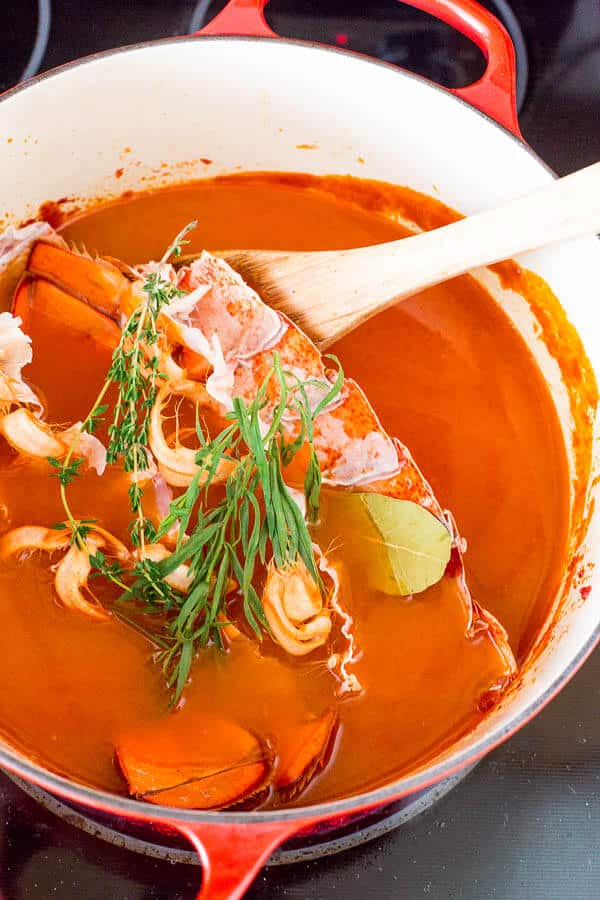
How to make lobster bisque from scratch
1. Cook the lobster tail
- Place the entire lobster tail, shell, and meat, into a pot of boiling water, and cook for about 8 minutes.
- Cool the lobster tail, and remove the meat. I like to use a sharp knife, but kitchen shears also work great for this step!
- Cut the lobster tails in half lengthwise, carve out the meat with a fork, and chop it into small pieces.
- Save the lobster meat, shells, and 2 cups of lobster cooking water. You’ll use this later!
2. Make lobster broth
The secret to the best lobster bisque soup recipe is in the stock. And it’s easy to make! However, in a pinch, you could substitute seafood stock for the homemade lobster stock.
- Melt the butter in a large pot.
- Add the shallot, garlic, and celery, and sauté until tender and fragrant.
- Stir in the tomato paste. Then, cook for a few minutes, stirring frequently, over medium-low heat.
- Pour in the wine, and scrape the bottom of the pot to deglaze it. The little browned bits add so much flavor to the bisque!
- Add the reserved lobster shells, lobster cooking water, chicken stock, and herbs.
- Bring the liquid to a boil. Then, reduce the heat, and simmer uncovered for an hour.
- Strain the broth, and discard the shells.
3. Make the bisque
- Make a roux by toasting the flour in bacon fat, melted butter, or a mixture of the two. This is key to thickening the bisque!
- Add the homemade lobster broth and heavy cream, and bring the mixture to a simmer.
- Stir in the chopped lobster meat, and serve warm.

Tips for Success
- If possible, make your own lobster bisque rather than using store-bought varieties. It truly does add SO much flavor!
- Avoid overcooking the lobster, or it will be tough and rubbery in your soup. Boil just until the shells turn bright red, and transfer the tails to a cutting board.
- Cut the cooked lobster meat into bite-sized pieces so you get a little bit in every bite.
- Don’t toss out the lobster shells! They add the best flavor to the broth.
- Be careful not to burn the roux. It turns from perfectly golden to burnt quickly. So, keep a close eye on it, and don’t walk away from the stove.
- Use room temperature cream to prevent it from curdling or clumping as it simmers.
Make-Ahead Tips
- Boil the lobster 1-2 days ahead of time, and store it in an airtight container in the fridge. Then, all you have to do is combine the ingredients, simmer, and serve!
- Prepare the lobster broth ahead of time, and store it in the fridge for up to 3 days. Or, freeze it for up to 3 months! I love to make baked lobster tails and use the tails to make broth to freeze for later.
- Chop the veggies 1-2 days in advance, and store them in an airtight container in the fridge.
Storing Tips
- Store leftover lobster bisque soup in an airtight container for up to 2 days.
- For the best results, reheat it in a pot over medium heat on the stove. You can microwave leftovers, but the lobster is likely to become a bit rubbery this way.
- I don’t recommend freezing leftovers, because the taste and texture aren’t great once thawed.

FAQs:
If you used a whole lobster carcass (including head and gills) to make the stock, it’s important not to cook it for too long as they tend lend a bitter taste to the stock. Instead remove head and gill parts and use only the shells.
There are 2 ways to thicken lobster bisque.
1. Roux is my preferred method for thickening bisques.
2. You can also add cornstarch slurry (cornstarch mixed with a little bit of water) into boiling soup to thicken it.
I recommend Pinot Grigio, Sauv Blanc, or Chardonnay. And make sure to choose a wine that you’d drink. (It doesn’t have to be expensive!) Here’s a great article about cooking with wine.

Restaurant-Quality Lobster Bisque
Ingredients
For lobster broth:
- 1 lb lobster tail thawed, if frozen
- 2 tablespoons unsalted butter
- 1 shallot chopped
- 1 celery stalk chopped
- 3-5 garlic cloves smashed
- 2/3 cup (160 ml) white wine
- ¼ cup tomato paste
- 3 cups (720 ml) chicken stock
- 1 sprig fresh thyme
- 1 sprig fresh tarragon
- 1 dried bay leaf
- 1 teaspoon coarse kosher salt or sea salt
For bisque:
- 2 tablespoons butter
- 2 tablespoons bacon fat you can substitute all butter
- ¼ cup (30 g) all-purpose flour
- 1 cup heavy whipping cream
- Cayenne pepper and crackers for garnish
Instructions
To cook lobster tails:
- Fill a large dutch oven with 1 quart of water and bring it a boil.
- Add thawed lobster tail and bring it to a boil. Reduce heat and simmer for about 8 minutes, or until the shells turn bright red. Using a pair of kitchen tongs, transfer the lobster tail onto a cutting board. Cool slightly.
- Using a sharp knife or kitchen shears, cut the lobster tail in half lengthwise, as shown above. Carve out the meat and chop into small pieces. Reserve lobster meat, shells and 2 cups of lobster cooking water.
To make lobster broth:
- Heat butter in a large dutch oven over medium high heat. Add shallot, garlic, and celery, and saute for about 3 minutes, stirring occasionally.
- Reduce heat to medium low and stir in tomato paste and cook for another 3 minutes.
- Add wine and deglaze the pan. Cook for another 2 minutes. Then add the reserved lobster shells, 2 cups of lobster cooking water, chicken stock, thyme, tarragon, bay leaf and salt. Bring it to a boil. Then reduce heat to medium and simmer for 1 hour, covered.
- Strain the broth through a fine mash sieve, making sure to extract as much liquid as possible.
To make the bisque:
- Melt butter and bacon fat in a large dutch oven over medium heat. Stir in flour and cook until nice and golden, stirring constantly, for about 5 minutes. It should smell slightly nutty. (Be careful not to burn!)
- Add the prepared lobster broth and heavy cream and bring it to a simmer.
- Stir in chopped lobster meat and serve with crackers. Garnish with cayenne pepper and thyme, if desired.
⭐️ Did you make this recipe?
Please leave a review and let us know how you liked it!
Tips & Notes
– Store leftover lobster bisque soup in an airtight container for up to 2 days.
– Reheat it in a pot over medium heat on the stove. You can microwave leftovers, but the lobster is likely to become a bit rubbery this way.
– I don’t recommend freezing leftovers, because the taste and texture aren’t great once thawed.
Nutrition

This recipe was originally published in December 2016.





I made this tonight almost exactly as written. It truly was restaurant quality. Absolutely delicious.
The changes I made: salted butter-1/2 tsp dried thyme and 1/2 tsp dried tarragon-no bacon fat-
1 1/2cups lobster cooking water-1 1/2 cups heavy cream.
Not really much of a difference. It smelled so good while cooking and the first spoonful was luscious.
Thanks
Hi, Kate! I’m SO glad you tried and loved this readers’ favorite soup. Thank you for sharing your feedback and adjustments!!
It definitely sounds like it would taste good but I wouldn’t call this restaurant quality. For quality bisque using better technique and no chicken broth, roux, or bacon, I recommend Alton Brown’s recipe.
I have homemade lobster stock… can I use that or should I stick with chicken stock?
Hi, Nicole. I’d use lobster stock. Hope you’ll enjoy!
I can’t tell you how happy I am to have this recipe! It is delicious and better than some I have had in a fine restraunt! Thank you
think it needs more lobster – I doubled it but will use more next tome
Thanks, Laura, for choosing my recipe and for your feedback!!!
Question: how much broth does this make?
About 4-4.5 cups, depending on how much evaporates during simmering.
Thank you!
It was surprising good and not that difficult to do. It was my first time making it. This is a keeper! I didn’t use fresh thyme or tarragon, I did use dried and it was still fantastic. I used what I had on hand.
SO glad you loved it, Victoria! Thank you for your feedback!
I have been making this soup for a couple years now and people are amazed at how delicious it is! I often get comments that it is better than what you would get in a fine dining restaurant. My only note is to be careful of the bacon fat as although delicious, too much kind of takes over the soup. I typically use 1/4 bacon fat and 3/4 butter, but that’s my taste.
Soooo here I am again making the stock (triple batch!) for the annual Christmas Eve soup dinner! Hoping there is some extra as it freezes beautifully as long as you are careful to re heat very slowly due to the cream. Happy Holidays!
Thank you SO much for your feedback and coming back to the recipe year after year! Merry Christmas, Heidi!
Hi! I made this last year, and it was simply perfection. I want to make the bisque again for Christmas Eve, but I have a guest with a gluten intolerance. What are your thought about using corn starch or another idea you may have to substitute the flour with? Thank you so much!
Hi, Meg. So glad you enjoyed this bisque last year! For gluten-free version, you could use gluten-free flour. This would be my preferred method, because roux adds more flavor. Or as you suggested, you can use cornstarch slurry. I’m not sure exactly on measurements, but I’d start with 2 tablespoons of cornstarch mixed with 2 tablespoons of water. Add it to the boiling broth. Add more cornstarch (mixed with water) as needed until desired thickness.
Hi! What if I don’t have a dutch oven? What would you recommend?
Hi, Haley. You could use any type of saucepan that you use for making soups.