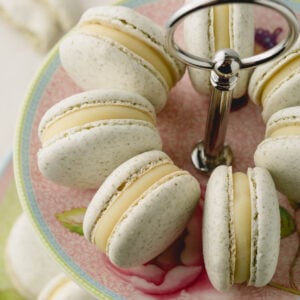
Nut Free Macarons with Pumpkin Seeds
Servings: 20 filled macarons
Calories: 103kcal
Learn how to make nut-free macarons with ground pumpkin seeds! These delicate French macarons have crisp shells, chewy centers, and those pretty ruffled feet. And NOBODY will guess they're made without almond flour.
Print Recipe
Ingredients
- 70 g pumpkin seeds Note 1
- 30 g gluten-free flour Note 2
- 65 g powdered sugar Note 3
- 70 g egg whites Note 4
- 75 g granulated sugar Note 5
- ¼ teaspoon cream of tartar Note 6
- ¼ teaspoon coarse kosher salt
- Filling of your choice
Instructions
- Preheat the oven to 300°F (150°C). Line 2 baking sheets with parchment paper, or a Teflon sheet, or a silicone mat.
- To prepare dry ingredients, place pumpkin seeds in a large food processor and pulse until finely ground. Transfer the ground pumpkin seeds to a sifter and sift, discarding the larger pieces.
- Weigh out 70 g of finely ground pumpkin seeds, then combine with the flour and powdered sugar.
- Sift the dry ingredients twice. (Note: If you have up to 2 tablespoons of chunky dry ingredients left in the sifter, you don't have to replace it. Simply discard those chunky bits.)
- To make meringue, in a clean mixing bowl with a whisk attachment, combine egg whites, granulated sugar, cream of tartar, and salt, and beat the mixture on medium speed until soft peaks form. (I set it to speed 4 on my KitchenAid stand mixer. It takes 30-40 minutes to whip the meringue, but it's well worth it for nice and full shells.)
- If you’re making colored shells, add gel food coloring at the soft peak stage.
- Continue beating the meringue at the same medium speed until hard peaks form. Visual cues: The meringue should ball up in the whisk, and when you lift the whisk, it should hold a pointy tip and have sharp ribs.
- To make batter, sift the pumpkin seed mixture into the meringue. Using a silicone spatula, fold the dry ingredients into the meringue until fully incorporated. To test, drop a small amount of batter and drop it into the bowl. If the small peaks dissolve into the batter on their own in about 10 seconds, the batter is ready. If not, fold a couple more times and test again. Be careful not to over-fold the batter. (TIP: Making French macarons is all about the technique. This is one of the most crucial steps. Let me describe the folding motion as best I can: run the spatula clockwise from the bottom, up around the sides, and cut the batter in half. If you’re a beginner macaron baker, I suggest counting every fold. It takes roughly about 50 folds to reach the proper consistency. After 50 folds, start testing the batter, and continue testing after every couple of folds.)
- To pipe macaron shells, transfer the batter into a pastry bag, fitted with a round piping tip. (I use this Wilton 2A tip.)
- Hold the pastry bag at a straight 90° angle and pipe about 1.5-inch rounds about an inch apart on prepared baking sheets.
- Tap the baking sheets firmly on the counter (or slap the bottom of the baking sheet with one of your hands) a few times to get rid of any air bubbles. You can also use a toothpick to burst some large air bubbles. This step ensures smooth tops.
- Let the macarons rest on the counter for 15 minutes before baking.
- To bake, bake the macarons for 15-18 minutes, one baking sheet at a time, on the middle rack. Larger macarons will take longer. To test for doneness, touch a macaron lightly and try to move it. If it slides and wobbles, bake a minute or so longer. The cooked macarons should be firm to the touch, and the base shouldn’t move.
- Cool the macarons completely and then remove the shells from the baking surface. (TIP: Don't remove the shells while warm; you may break them, or the bottom might stick to the baking surface.)
- TO ASSEMBLE MACARONS:
- Pair the macaron shells by size and arrange them on a wire rack. Line them up so that bottom shells are upside down.
- Pipe a dollop of filling of your choice on bottom shells. Place the top shell over the filling and press lightly so the filling spreads to the edges.
- Refrigerate the filled macarons in an airtight container for at least 24 hours to mature, which allows the filling to soften and flavor the shells.
- To serve, bring the macarons out about 30 minutes prior to serving.
Notes
Note 1: Use raw, unsalted, shelled pumpkin seeds (aka pepitas). Roasted or salted seeds will change the flavor and color.
Note 2: I tested this recipe with Bob's Red Mill gluten-free flour. You can use all-purpose flour instead.
Note 3: I don’t recommend making your own powdered sugar because commercial powdered sugar contains cornstarch. And it helps with the texture of the cookies.
Note 4: I’ve had success with carton egg whites (Bob Evans brand, #notsponsored). You’ll need 1/3 cup of egg whites.
Note 5: Use fine granulated sugar for meringue, as it dissolves faster. You can also use caster sugar, aka baker’s sugar.
Note 6: Cream of tartar is optional and can be omitted. However, it helps to stabilize egg whites and create sturdier meringue. It’s just extra insurance!
Note 7: You can easily double this macaron recipe.
GOT MACARON TROUBLE? Check out my macaron troubleshooting guide.
Storage:
- Unfilled shells: Store in an airtight container at room temperature for up to 5 days, or freeze for up to 3 months.
- Filled macarons: Refrigerate in an airtight container for up to 5 days (depending on the filling), or freeze for up to 1 month. Thaw in the fridge for at least 1 hour.
- Unfilled shells: Store in an airtight container at room temperature for up to 5 days, or freeze for up to 3 months.
- Filled macarons: Refrigerate in an airtight container for up to 5 days (depending on the filling), or freeze for up to 1 month. Thaw in the fridge for at least 1 hour.
Nutrition
Calories: 103kcal
Carbohydrates: 16g
Protein: 2g
Fat: 4g
Sugar: 14g
Sodium: 58mg
